
Football · Speed
The .15 Nobody Talks About
How surface conditions can affect timed sprint testing — and why controlled comparisons matter.
5 min read
Performance Footwear Springsoles
 Made in the USA
Patented, ultra-thin Springbak® Springsoles add a 3/32-inch resilient layer to compatible athletic and everyday footwear. Placement depends on the shoe’s factory liner: try the Springsole underneath a removable liner when it releases cleanly, or place it on top when the liner stays in place. Confirm actual fit in your own footwear.
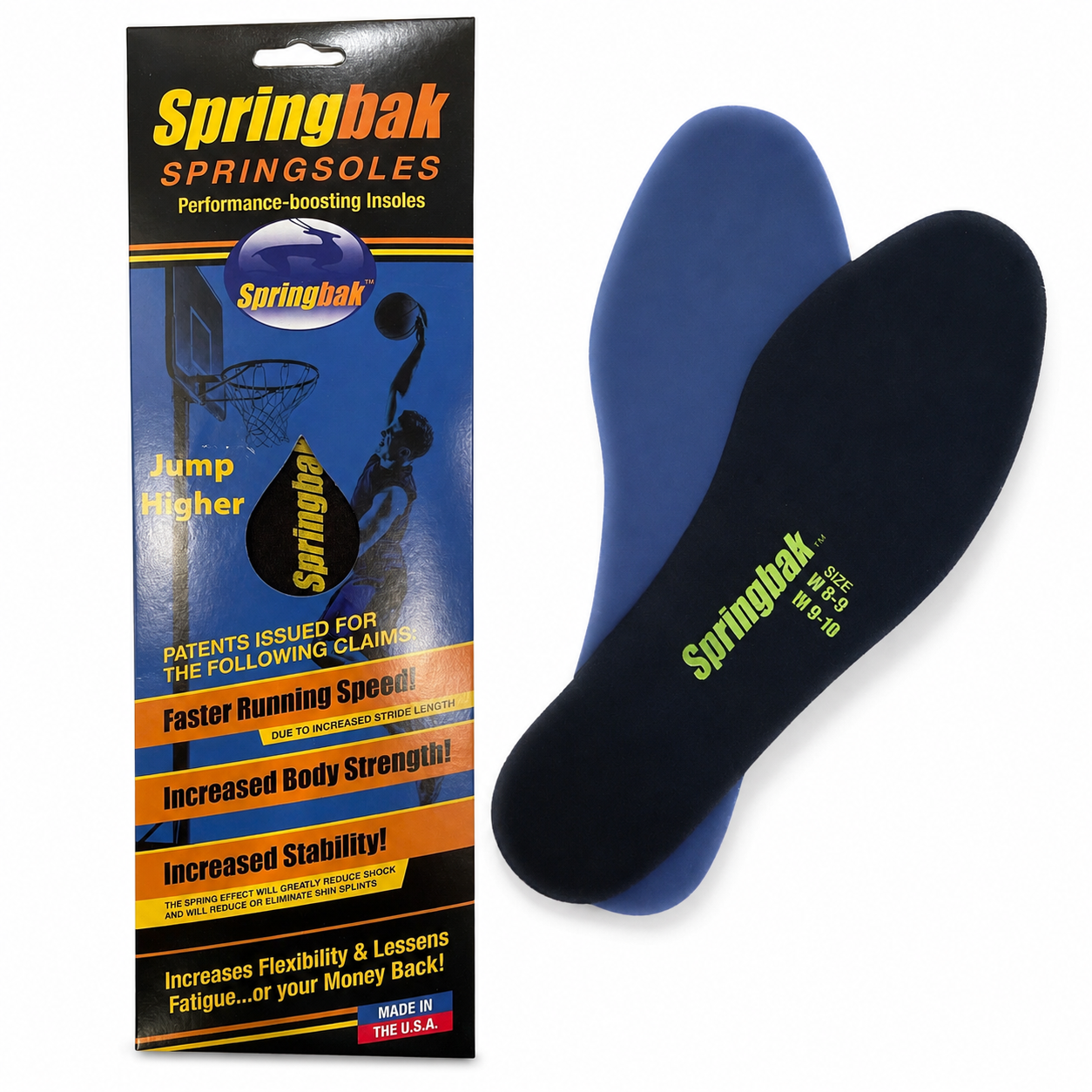
The Springbak layer is designed to compress under load and return toward its shape. Energy return is the intended material function, not a measured athlete-performance result.
Weber State force-plate testing found that more than twice the force was required to displace a person standing on Springsoles compared with standing without them.
Four U.S. patents cover Springbak shoe-component technology and methods.

Weber State standing test
Weber State force-plate testing found that more than twice the force was required to displace a person standing on Springsoles compared with standing without them. This was a standing resistance-to-displacement measurement. It did not directly measure walking stability, gait, fall prevention, fall risk, pain, strength improvement or performance during everyday movement.
Weber State force-plate testing found that more than twice the force was required to displace a person standing on Springsoles compared with standing without them.
This was a standing resistance-to-displacement measurement. It did not directly measure sprint speed, jump height, balance during movement, fall prevention, pain, fatigue or sports performance.
Athletic and everyday uses are product applications, not outcomes measured in this force-plate test.
Results are from the force-plate testing described in U.S. Patent No. 6,589,630 B1. Individual results vary.
Insoles by sport
Movement demands, fitting notes and training for the shoes, cleats and spikes you already compete in.
pickleball insoles
basketball insoles
football insoles for cleats
sprinting insoles
baseball insoles
volleyball insoles
soccer insoles for cleats
golf insoles
insoles for the weight room
New: pickleball insoles for court shoes and hard-court play, basketball insoles for jumping, cutting and closing out and Springsoles for seniors and the Weber State standing test.
Each pair adds a thin 3/32-inch resilient 1,4-polybutadiene layer to compatible footwear. Springbak® Springsoles are made in the USA and backed by four U.S. patents. Choose your size, follow the liner-based installation guidance and confirm actual fit in your own shoes.
$29.95live store price
The Edge
Football · Speed
How surface conditions can affect timed sprint testing — and why controlled comparisons matter.
5 min read

Basketball · Vertical
A look at takeoff mechanics, ground contact and how to test changes consistently.
6 min read
All Sports · Mechanics
How fatigue can change movement quality and how athletes can structure technique work later in a session.
5 min read

Soccer · Speed
A coaching look at short acceleration, positioning and first-step mechanics.
4 min read
All Sports · Mechanics
A plain-language look at Springbak’s four U.S. patents and what the patent claims cover.
6 min read
Train
6 weeks · 3x / week
Six weeks of short acceleration drills, sprint mechanics and timed testing.
8 weeks · 3x / week
Eight weeks of strength, takeoff mechanics and repeatable jump testing.
12 weeks · 2x / week
Two weekly sessions focused on maintaining strength while managing training volume.
5 weeks · 3x / week
Five weeks of cutting, planting, deceleration and re-acceleration drills.
6 weeks · 3x / week
Six weeks of split-step timing, lateral movement and court-conditioning work.
8 weeks · 3x / week
Eight weeks of graded balance and strength training with repeatable progress checks.
Record a baseline, change one variable and re-test under the same conditions. Athlete Tools can log vertical-jump and sprint measurements so you can compare your own results. This is a personal self-test, not laboratory proof of a guaranteed performance improvement.
Open athlete toolsThe receipts
4
U.S. patents
Nos. 5,554,694, 5,695,850, 6,120,880, 6,589,630 B1 — performance-enhancing athletic shoe components and methods.
Read the patent family2×+
Force to displace
Weber State force-plate testing found that more than twice the force was required to displace a person standing on Springsoles compared with standing without them.
See the force plate dataBalance
& stability study
Evaluated with Dr. Michael Yessis, Dr. Robert Wiswell and Howard Gray, PhD. The force plate measured standing resistance to displacement. Researcher interpretations about strength or stability are attributed interpretations, not separate measurements of strength, walking, athletic movement or sports performance.
Read the study