

Technology
How our technology delivers peak performance
Every movement in sports begins at the ground. Springbak® Springsoles give you a lightweight, ultra-thin foundation inside the athletic shoes you already trust — without changing their fit.
3/32 in
Thickness
4
U.S. patents
+15%
Butadiene resilience
30+
Years refining
Faster how?
There is a time-honored formula for improving running speed: shorten footplant time and increase stride length. Running on a resilient surface such as a rubberized track accomplishes both. NFL combine scouts know it as fact — they deduct .15 of a second from a 40-yard dash run on artificial turf versus a rubberized track.
Unless your sport is track and field, you do not compete on a rubberized surface. There is a way to make your playing surface behave like one: put material far more resilient than a rubberized track inside your athletic shoes. Dirt, grass, concrete, hardwood or turf — you carry the benefit with you.
What it is made of
Springsoles are built from two of the most resilient materials in the world: natural rubber for flexibility and comfort, and butadiene rubber — which carries roughly 15% more resilience than any other material — for response and durability. The proprietary blend includes 1,4-polybutadiene, selected for its physical and vibration-response characteristics.
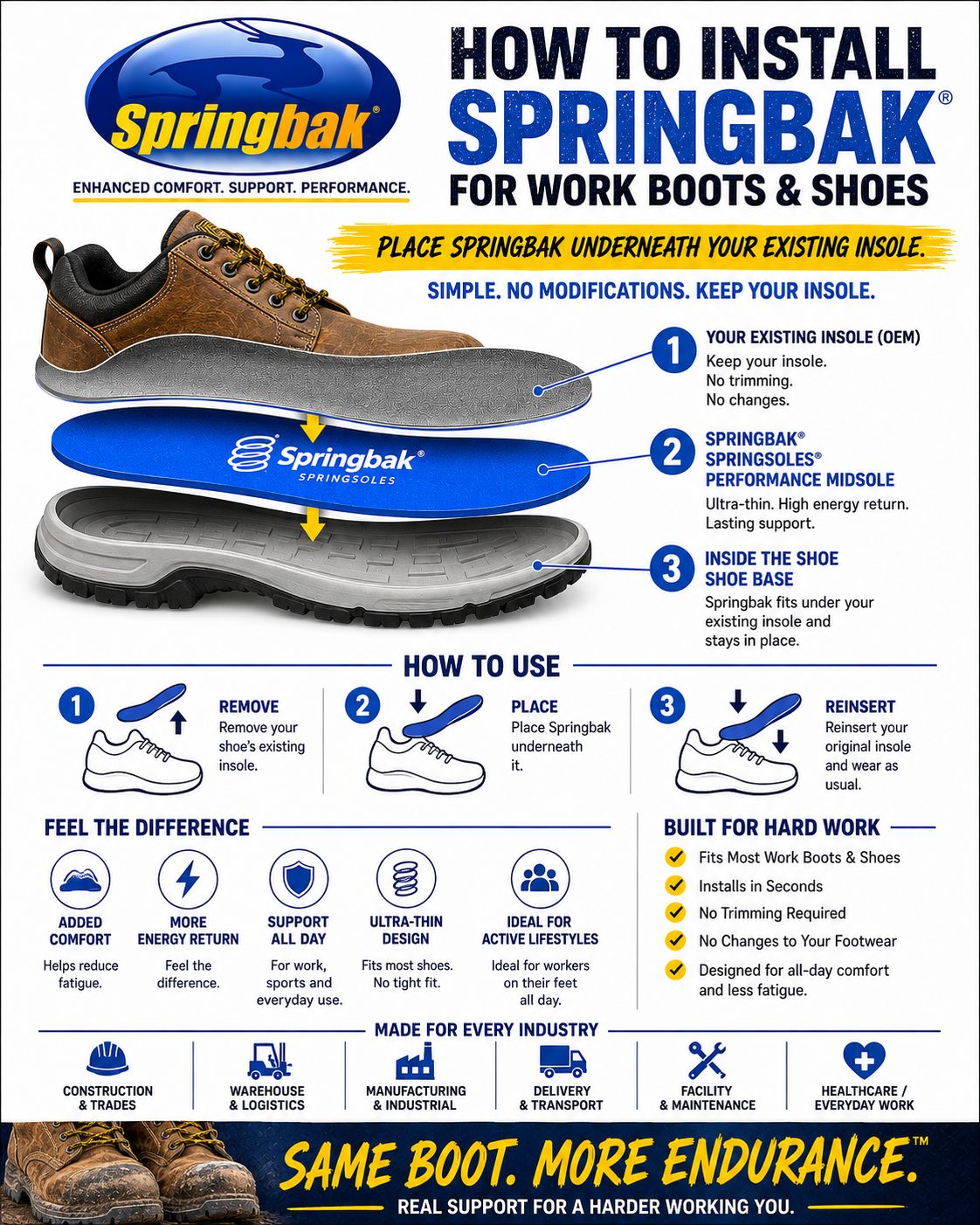
It fits under your shoe's existing insole, snug against the hard surface of the shoe, and is custom trimmed to your foot. At only 3/32nds of an inch thick, there is no need to change your shoe size.
How to install them
- Try the Springsole without trimming first.
- If the factory liner is removable, remove it and place the Springsole underneath it.
- If the liner is lightly glued, gently pull to see whether it releases cleanly. If it does, place the Springsole underneath it.
- If the liner begins to tear, stretch, deform, or resist removal, stop and leave it in place. Put the Springsole on top instead.
- Never force out a firmly bonded or stitched liner.
- Trim only if needed for a flat fit, starting at the toe/forefoot and removing a very small amount at a time.
- Do not trim the heel and do not unnecessarily narrow the sides.
- Recheck the fit after every small trim.
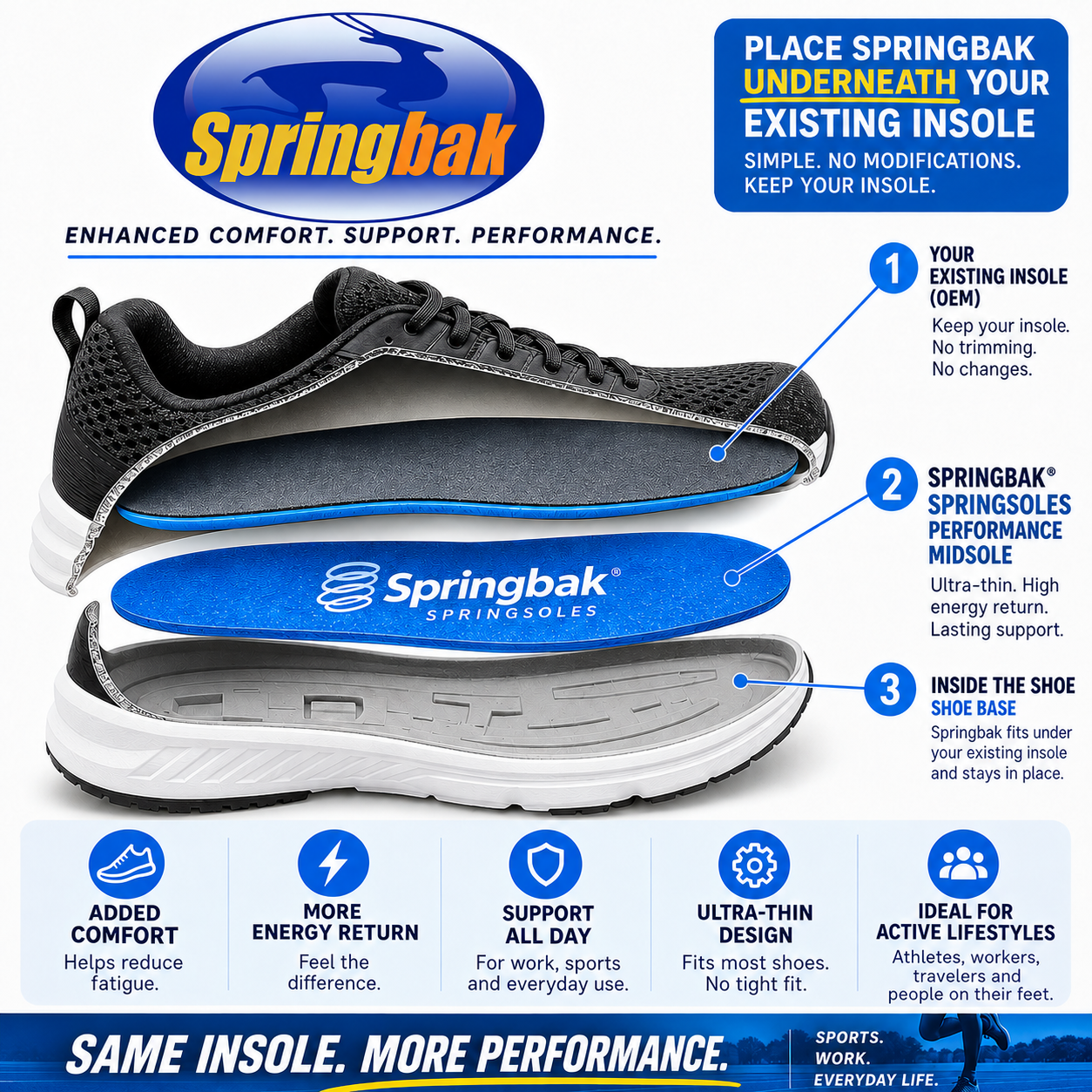
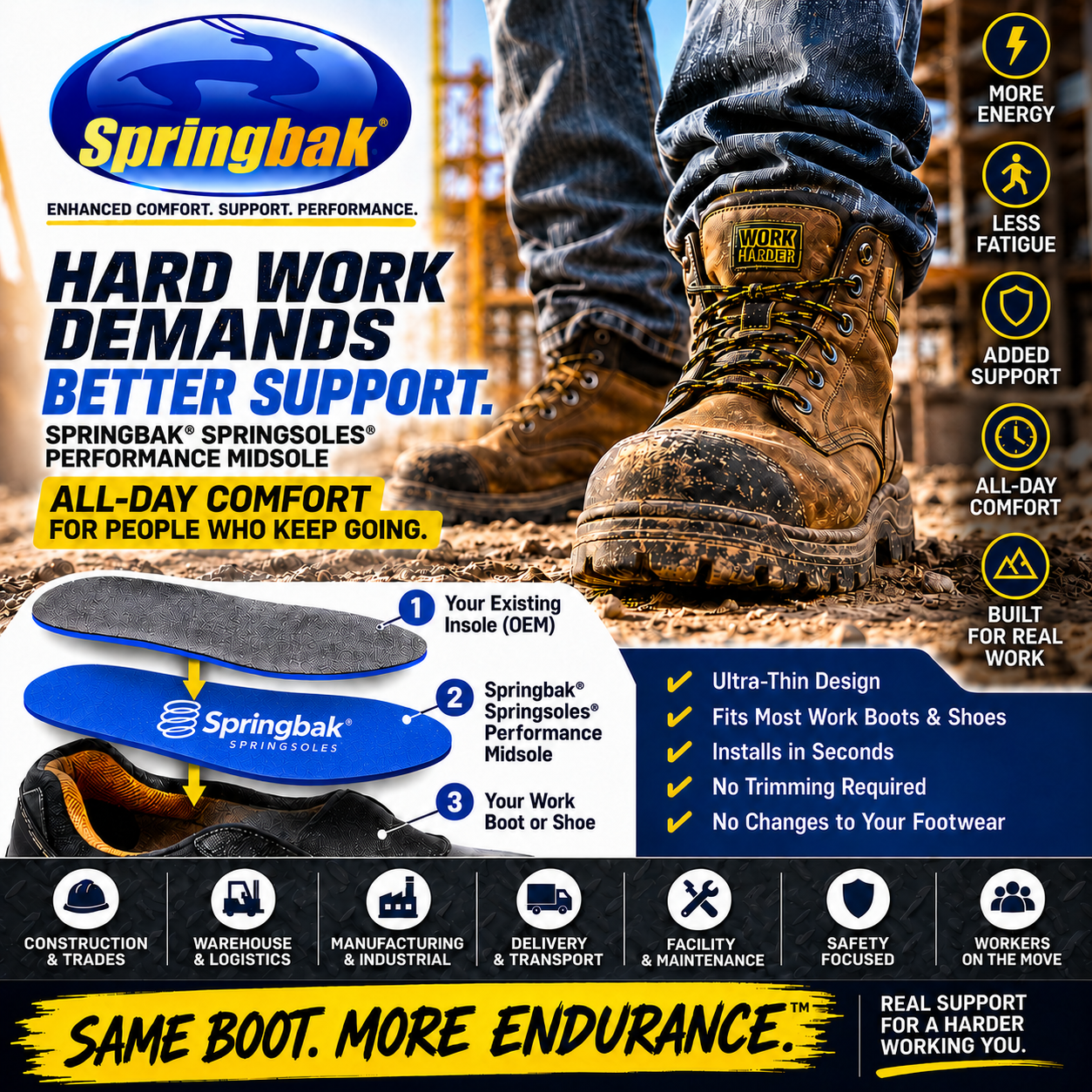
Work boots and everyday shoes
The same technology works for people on their feet all day — construction, warehouse, delivery, healthcare and everyday walking.
The patents
Inventor William R. Crow received U.S. Patent Nos. 5,554,694, 5,695,850, 6,120,880 and 6,589,630 B1 — the first patents ever issued under the performance-enhancing athletic shoe component category — covering resilient performance materials in shoe inserts, insoles, midsoles and soles.
For the patent numbers, filing and grant dates, inventor and the laboratory findings side by side, see the Springbak® patent family and force plate testing. For the performance testing written into the issued patent itself — energy return ranges, jump measurements and peak-work figures — read Springbak® patented performance and proprietary technology.
Force-Plate Stability Study
In force-plate testing, subjects standing on Springbak® Springsoles showed more than twice the overall resistance to being pushed from their position.
In plain English: they were harder to move. They could hold their ground better against a sideways push—exactly the kind of stability athletes need when planting, cutting, jumping, landing, and absorbing contact.
Springbak® gives the foot a more stable, responsive platform to work from inside the shoe.
Results are from the force-plate testing described in U.S. Patent No. 6,589,630 B1. Individual results vary.
Laboratory evaluation
At the Weber State University Human Performance Laboratory, Dr. Howard Gray used force plate analysis and found athletes wearing Springsoles required more than twice the force to be displaced, concluding a significant increase in stability and functional strength under laboratory conditions.
At the University of Southern California, Dr. Robert Wiswell's treadmill analysis found athletes wearing Springsoles took fewer strides over the same distance than with placebo inserts — consistent with increased stride length.
Individual results vary. Springbak® — MADE IN THE USA.